19 February 2009

Yeah .. bring 'em on!


"In small areas, before small electorates, a first-rate man occasionally fights his way through, carrying even the mob with him by force of his personality. But when the field is nationwide, and the fight must be waged chiefly at second and third hand, and the force of personality cannot so readily make itself felt, then all the odds are on the man who is, intrinsically, the most devious and mediocre — the man who can most easily adeptly disperse the notion that his mind is a virtual vacuum.

The Presidency tends, year by year, to go to such men. As democracy is perfected, the office represents, more and more closely, the inner soul of the people. We move toward a lofty ideal. On some great and glorious day the plain folks of the land will reach their heart's desire at last, and the White House will be adorned by a downright moron."

  ... H.L. Mencken (1880-1956)

11 February 2009

Raunchiness par excellence!


American writer Henry Miller (1891-1980) [pictured here in the mid 30s] celebrated Bohemian ex-pat life in Paris in the early 1900’s, as deliciously depicted in such novel-memoirs as Tropic of Cancer.

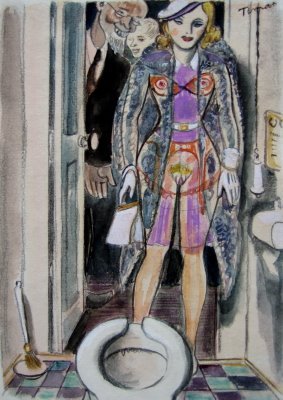
Another ex-pat in Paris at the time was the Hungarian artist Emeric Timar (1898-1950) who was inspired enough by Miller’s accounts to create expressionist lithographs with a surrealist edge capturing the raw sexuality that permeates pretty well everything Miller wrote. They were made in 1949.


Presented here juxtaposed with the sombre looking Miller is Timar's “The American Girl” in water colour. Miller apparently disliked them, perhaps because for the title page vignette Timar drew Miller with a penis for a nose.

01 February 2009

The Union endures!


“… there is a physical difference between the white and black races, which … will forever forbid the two races living together upon terms of social and political equality”

Abraham Lincoln (1809-65)

The sedge has wither’d from the lake, and no birds sing


"Notwithstanding your happiness and your recommendations, I hope I shall never marry: though the most beautiful creature were waiting for me at the end of a journey or a walk; though the carpet were of silk, and the curtains of the morning clouds, the chairs and sofas stuffed with cygnet’s down, the food manna, the wine beyond claret, the window opening on Winandermere, I should not feel, or rather my happiness should not be, so fine; my solitude is sublime—for, instead of what I have described, there is a sublimity to welcome me home; the roaring of the wind is my wife; and the stars through the window-panes are my children; the mighty abstract Idea of Beauty in all things, I have, stifles the more divided and minute domestic happiness.... I feel more and more every day, as my imagination strengthens, that I do not live in this world alone, but in a thousand worlds. No sooner am I alone, than shapes of epic greatness are stationed around me, and serve my spirit the office which is equivalent to a King’s Body-guard: “then Tragedy with scepter’d pall comes sweeping by:” according to my state of mind, I am with Achilles shouting in the trenches, or with Theocritus in the vales of Sicily; or throw my whole being into Troilus, and, repeating those lines, “I wander like a lost soul upon the Stygian bank, staying for waftage,” I melt into the air with a voluptuousness so delicate, that I am content to be alone.”

  ...  John Keats (1795-1821) from a letter written 29Oct1818 to his brother George. Keats was 23.

30 January 2009

The dreadful face of unfeeling ignorance or evil or both

"the negro might justly and lawfully be reduced to slavery for his benefit"


In March of 1857, a case before the United States Supreme Court, led by Chief Justice Roger B. Taney [pictured in 1855 at 78], concerned Dred Scott, a slave who had appealed to the Court in hopes of being granted his freedom. Taney wrote in a majority opinion that the framers of the Constitution believed that blacks "had no rights which the white man was bound to respect; and that the negro might justly and lawfully be reduced to slavery for his benefit. He was bought and sold and treated as an ordinary article of merchandise and traffic, whenever profit could be made by it”. Referring to the language in the Declaration of Independence that includes the phrase, "all men are created equal", Taney maintained that "it is too clear for dispute, that the enslaved African race were not intended to be included, and formed no part of the people who framed and adopted this declaration. . . ."

23 December 2008

Shakespeare certainly had a way with words!


In his poems and plays, Shakespeare (1564-1616) invented thousands of words, often combining or contorting Latin, French and native roots. His impressive expansion of the English language, according to the Oxford English Dictionary, includes such words as: arch-villain, birthplace, bloodsucking, courtship, dewdrop, downstairs, fanged, heartsore, hunchbacked, leapfrog, misquote, pageantry, radiance, schoolboy, stillborn, watchdog, and zany.

The following phrases are also attributed to Shakespeare´s uncanny way with words:

“... has seen better days” (As You Like It)
“... hasn’t slept a wink” (Troilus and Cressida)
“... foul play” (Hamlet)
“... dead as a doornail” (Henry VI)
“... beggared all description” (Antony & Cleopatra)
“... set my teeth on edge” (Henry IV)
“... it was early days” (Troilus and Cressida)
“... as good as luck would have it” (The Merry Wives of Windsor)
“... laugh yourself into stitches” (Othello)
“... a foregone conclusion” (Othello)
“... one fell swoop” (Macbeth)
“... the game is up” (Cymbeline)
“... tell truth and shame the devil” (Henry IV)
“... to give the devil his due” (Henry V)
“... he knits his brow” (Henry VI)
“... what the dickens” (The Merry Wives of Windsor)
“... make a virtue out of necessity” (Two Gentlemen of Verona)

“... with bated breath” (The Merchant of Venice)
“... neither rhyme nor reason” (As You Like It)
“... in such a pickle” (The Tempest)
“... playing fast and lose” (King John)

“... living in fools paradise” (Romeo & Juliet)
"... wanting too much of a good thing” (The Merchant of Venice)

“... in the end truth will out” (The Merchant of Venice)
“... melt into thin air” (The Tempest)

“... love is blind” (The Merchant of Venice)
“... tower of strength” (Richard III)
“... green-eyed jealousy” (The Merchant of Venice)
“... to be cruel only to be kind” (Hamlet)
“... more in sorrow than in anger” (Hamlet)
“... more sinned against than sinning" (King Lear)
“... be that as it may” (Henry VI)

“... the devil incarnate” (Titus Andronicus)
“... a good tongue in his head” (The Tempest)
“... don’t stand on ceremony” (Julius Caesar)
“... pomp and circumstance” (Othello)
“... not budging an inch” (The Taming of the Shrew)
“... making a laughing stock” (The Merry Wives of Windsor)

“... the be all and end all of it” (Macbeth)
“... brevity is the soul if wit” (Hamlet)

20 December 2008

Fame ... dotes the more upon a heart at ease

... carefree at a time when most struggled simply to survive
Michel de Montaigne was a noted writer of the Renaissance, living from 1533 to 1592, in a France dominated by bloody and miserable civil war. Even then, his inherited wealth shielded him from personal adversity allowing for a largely leisurely private secluded life. He wrote essais (“tries”). They were supposedly not meant as pedantic treatises, but as “sincere” attempts or experiments.

He was privileged, and he wrote extensively because he was carefree at a time when most struggled simply to survive. He wrote about the experience of being lazy, or brave, or indecisive; about lying, about living up to one’s responsibilities (provided one could afford to), about obsessive fears of death or illness, and the way they seem to recede as one’s level of actual misfortune rises. He often described the sheer pleasure of being alive - a sensation he could enhance simply because he was in a position to do so unfettered by practical living matters or concerns.

For some reason, he had quite a following in his time and beyond. The likes of Descartes, Emerson, Nietzsche, Rousseau, and perhaps Shakespeare were supposed to have been influenced. Even more contemporary writers like Isaac Asimov and Simone de Beauvoir had time for him.

Here’s a Montaigne sampler:

> "Obsession is the wellspring of genius and madness."
> "Everyone calls barbarity what he is not accustomed to."
> "If you belittle yourself, you are believed; if you praise yourself, you are disbelieved."
> "When I play with my cat, how do I know that she is not passing time with me rather than I with her? "
> "Life in itself is neither good nor evil, it is the place of good and evil, according to what you make it."
> "The continuous work of our life is to build death."
> "If you press me to say why I loved him, I can say no more than because he was he, and I was I."
> "Kings and philosophers deficate, and so do ladies."
> "I enter into discussion and argument with great freedom and ease, inasmuch as opinion finds me in a bad soil to penetrate and take deep root in. No propositions astonish me, no belief offends me, whatever contrast it offers to my own. There is no fancy so frivolous and so extravagant that it does not seem to me quite suitable to the production of the human mind. "
> "Our religion is made to eradicate vices, instead it encourages them, covers them, and nurtures them."

19 December 2008

"Sorry, Charlie"


Apparently this is Charlie Chaplin 's (1889-1977) "true" first love. It is said he fell madly in love with her and asked her to marry him (she was 15, he 19). When she refused, he suggested it would be best if they did not see each other again, and was reportedly crushed when she agreed. For years, her memory would remain a fetish with Chaplin. He was devastated in 1921 when he learned that she had died of influenza during the Great Flu Pandemic of 1918 (age 22). Some speculation lingered for a while over whether they had a child.

12 December 2008

Wealth of Nations


The total value of all wealth worldwide is about $100 trillion (US). Two thirds of that is held by Europe and North America, each holding some $34 trillion.

Individually, millionaires worldwide (about 10 million, comprising less than 1% of all households) hold one third of all global wealth. The five countries having the most millionaires (in order) are the US, Japan, the U.K, Germany, and China.

[Source: BCG]

11 December 2008

The one that got away ... maybe.


"Frank Harris was an objectionable little man. He was sallow as a gypsy. He had bat ears, dark hair with a crinkle in it that grew low on the forehead, and a truculent mustache. People remarked on the richness of his bass voice. His charm was great, particularly for the opposite sex. He had the gift of gab to a sublime degree and a streak of deep scoundrelism that was the ruin of him.

A natural storyteller, tall tales so permeated his private life that his biographers were hard put to disentangle any facts at all from the web of fiction he spun about himself. Particularly in the twenties, when he was editing Pearson's Magazine in New York, there used to be considerable journalistic searching for "the real Frank Harris." One wonders now if such a creature ever existed. He wrote some good short stories. He might have developed into a first-rate novelist if he hadn't been such a damn liar."    

     ...  John Dos Passos (1896-1970), American novelist


''Arriving in London at the age of twenty-six (1882), unknown, half educated, penniless, he was within two years editor of the Evening News. Very little later as editor of the Saturday Review, then a very powerful Tory paper, he was entertaining in his house in Park Lane many of the most prominent social and political personalities of the day. He went everywhere and saw everyone, and yet found time and energy both for his own writing and the conduct of innumerable intrigues. It had been suggested that his rapid progress was based like Maupassant's "Bel-Ami" on his success with women, and his first wife was a wealthy woman. But he was more than just another adventurer. He was a man of immense potentialities: yet it was all ruined - or mainly ruined - by the lie within himself.

Wilde said of him, 'Frank has dined in every stately home in London ... once.' He could capture ground with a sudden assault, but he could not hold it. He lost his friends, betrayed their trust - no one could rely on him; and that same noisiness, that ill-bred forcefulness that made him socially intolerable, spoilt him as a writer. His actual writing is poor. I did not realize quite how poor it was till I compared the French with the English version of My Life and Loves. His books are only readable because their subject matter is sensational. He had in The Man Shakespeare something new and definite to say. In several of his short stories he struck an exciting plot. In his Portraits he wrote intimately and indiscreetly of persons about whom one is inquisitive. Unfortunately you cannot believe a word he says.

His anecdotes about Maupassant's priapism and Carlyle's impotence are typical. He takes two rumours which probably have a basis in fact and makes them the subject of a confession. The men who are reported to have made these confessions are no longer in the world to contradict him or defend themselves. And who could believe the scene where he pretends to have been completely ignorant of Wilde's inclinations until the scandal broke? His memoirs are valueless as history. If he survives as a legend, as part of a pattern, as a motif in die mosaic of literary history during the close of the nineteenth and the opening of the twentieth centuries - that is the most that can be hoped for. But his effect in 1906 on a twenty-year-old poetess must have been apocalyptic. He was then in the middle fifties. Though his political career was ruined, his literary reputation was still untarnished. He had not yet alienated many of his more worth-while friends. He was, however, conscious of the tide's turn against him. He needed the adulation of the young to restore his self-esteem. He took trouble over the very young.

'Did you always lunch at the Café Royal?' I asked her.

'Except the last time. We lunched at Kettner's then.' She paused, hesitated. "Is Kettner's going still?' she asked. It was very flourishing, I told her.

'Is it still the same kind of place?'

'I suppose it is.'

'He took me to a private room.'

'I'm not sure if you'd find those still.'

Dinners in private rooms in restaurants went out with the modern flat. I saw the tail-end of their vogue. They would seem very unhygienic to a generation that is used to the centrally heated amenities of the modem apartment building, but there was a rakish rococo air about the whole procedure - the curtained stairway, the discreet waiters, the eighteenth-century engravings, the chaise-longue - that provided its own special stimulus; married couples got a kick out of going there and being mistaken for what they weren't.

'If that was your last lunch, I gather it wasn't a success,' I said.

She smiled, then flushed. 'I'm afraid he must have thought me very childish; girls weren't so sophisticated then. Ann Veronica seemed a very daring book. And besides, that room; it was tiny; I felt so big and clumsy. He was a little man, you know.'

She paused, smiled wryly. 'I must have been a disappointment to him. He never asked me out again. But he printed my poems: the poems I sent him afterwards. I was very happy about that. I should have been miserable if I'd thought he only accepted them because lie had thought I was the kind of girl who might-' She checked; there was an abstracted look upon her face. 'Did you read
My Life and Loves'?' she asked.

I nodded.

'They say, don't they, that the things which you regret in middle age are not the things you've done but the things you haven't done. That's not always true, you know. I was so glad I hadn't, when I read that book. I used to wonder sometimes when I read his other books and when I read about him, whether if I had behaved differently he might not have been a different person. There was so much that was fine in him. It all seemed to be going to waste. I might have saved him. But when I read that book, oh, it was all so materialistic, all that love-making and no conception of what love might be. I realized that I couldn't ever have made the slightest difference. It was too late, or I was the wrong person. I don't know which. Anyhow, I was very glad I hadn't.'

'You never saw him again, not after that last lunch?'

She shook her head. 'Very soon after that I went out to India: my sister was married to a civil servant.'

'You did not say good-bye?'

'I didn't tell him I was going. I dramatized myself. I pictured myself writing a tremendous poem on the way out. He'd be astonished to get an envelope in my handwriting with an Indian postmark. Then he'd read the poem. He'd be even more astonished. He'd feel guilty and ashamed. "I never realized she was capable of that," he'd think. My next poems would be better still. He'd be impatient to get me back. He'd write me beseeching letters. I'd go on postponing my return. That's how I'd punish him, for his own good. You know how a young girl daydreams.'

'And it didn't turn out that way at all?'


She laughed. 'The third day out I met the man I married.'

'And you wrote no more poems?'

'I wrote no more poems.' ''

     ... Alec Waugh (1898-1981), British novelist [excerpt, "My Place in the Bazaar"]


27 November 2008

Being and nothingness ... on a very small scale!


"An atom has a diameter of about 0.00000001 cm. The nucleus [at the centre] has a diameter of about 0.0000000000001 cm. If we had an atom and wished to see the nucleus, we would have to magnify it until the whole atom was the size of a large room, and then the nucleus would be a bare speck which you could just about make out with the eye, but very nearly all the weight of the atom is in that infinitesimal nucleus."

                        ... Richard Feynman (1918-1988), theoretical physicist

25 November 2008

Tender is the Butterfly


"… his talent was as natural as the pattern that was made by the dust on a butterfly’s wings. At one time he understood it no more than the butterfly did and he did not know when it was brushed or marred. Later he became conscious of his damaged wings and of their construction and he learned to think and could not fly any more because the love of flight was gone and he could only remember when it had been effortless."

   ... excerpt from A Moveable Feast (posthumus 1964 edition),  Hemingway (1899-1961) on Fitzgerald (1896-1940)

20 November 2008

The Moving Finger writes ...


The Moving Finger writes; and, having writ,
Moves on: nor all thy Piety nor Wit
Shall lure it back to cancel half a Line,
Nor all thy Tears wash out a Word of it.

 ... Omar Khayyam (1048-1131), Persian poet

02 November 2008

All About George


"Dear World, I am leaving because I am bored. I feel I have lived long enough. I am leaving you with your worries in this sweet cesspool. Good luck."

   ... George Sanders (1906-72), actor [suicide note]

27 September 2008

Forrest Gump in drag … with red lipstick


If this photo (above right) had been doctored (as the film clip inset above left from the movie Forrest Gump) it would be an amusing lark perhaps found in the back pages of a cheap tabloid magazine .. certainly not in the mainstream media, even momentarily. But it’s there alright, and real … even surreal, but soon (hopefully) to be relegated to the dust bin of historical mementoes of the fleeting bravado of a naĂŻve mind suddenly thrust into the public limelight, totally mesmerized while incapable of entertaining a single serious thought.

13 August 2008

A clean, well-lighted place


"It was the light of course but it is necessary that the place be clean and pleasant. You do not want music. Certainly you do not want music. Nor can you stand before a bar with dignity although that is all that is provided for these hours. What did he fear? It was not a fear or dread. It was a nothing that he knew too well. It was all a nothing and a man was a nothing too. It was only that and light was all it needed and a certain cleanness and order. Some lived in it and never felt it but he knew it all was nada y pues nada y nada y pues nada.
Our nada who art in nada, nada be thy name thy kingdom nada thy will be nada in nada as it is in nada. Give us this nada our daily nada and nada us our nada as we nada our nadas and nada us not into nada but deliver us from nada; pues nada. Hail nothing full of nothing, nothing is with thee.
He smiled and stood before a bar with a shining steam pressure coffee machine.
"What's yours?" asked the barman.
"Nada."
"Otro loco mas," said the barman and turned away.
"A little cup," said the waiter. The barman poured it for him.
"The light is very bright and pleasant but the bar is unpolished" the waiter said.
The barman looked at him but did not answer. It was too late at night for conversation.
"You want another copita?" the barman asked.
"No, thank you," said the waiter and went out.
He disliked bars and bodegas. A clean, well-lighted cafe was a very different thing. Now, without thinking further, he would go home to his room. He would lie in the bed and finally, with daylight, he would go to sleep. After all, he said to himself, it's probably only insomnia. Many must have it."

 ... Ernest Hemingway (1899-1961)

01 July 2008

The ultimate defensive weapon ... a screwdriver.


Asked in a closed Senate hearing room "whether three or four men couldn't smuggle units of an [atomic] bomb into New York and blow up the whole city",Oppenheimer (1904-67)responded, "Of course it could be done, and people could destroy New York." When a startled senator then followed by asking, "What instrument would you use to detect an atomic bomb hidden somewhere in a city?" Oppenheimer quipped, "A screwdriver" [to open each and every crate or suitcase]. There was no defense to nuclear terrorism and he felt there never would be. ... "

... American Prometheus: The Triumph and Tragedy of J Robert Oppenheimer"

29 June 2008

A Darwinian take on the evolution of new ideas

Max Planck (1858-1947) pictured here presenting Albert Einstein (1879-1955) the Max-Planck medal in Berlin (1929). whose prescient and revolutionary notion of “quanta” arguably launched the whole mystical, radically new and innovative field of Quantum Mechanics, had this to say about the Darwinian-like evolution of new ideas:

"A new scientific truth does not triumph by convincing its opponents and making them see the light, but rather because its opponents eventually die and a new generation grows up that is familiar with it."

Einstein never wholly embraced the implications of this new field of physics, Quantum Mechanics ("God does not play dice"), curiously bearing out Planck’s observation.

It’s a sad historical note that Planck’s second son to whom he had been particularly close was implicated by the Nazis in the failed assassination plot of Hitler and died a horrible death at the hands of the Gestapo. Planck died a broken old man two years later at 89.

15 June 2008

The smudged remnant of a famous name and the rage of a great mind!


Beethoven’s original title page of his monumental Eroica symphony bears the evidence. The great composer's assistant Ferdinand Ries tells the story in his contemporary biography of Beethoven:

"In writing this symphony Beethoven had been thinking of Bonaparte, but Bonaparte while he was First Consol. At that time Beethoven had the highest esteem for him and compared him to the greatest consuls of ancient Rome. Not only I, but many of Beethoven's closer friends, saw this symphony on his table, beautifully copied in manuscript, with the word 'Bonaparte' inscribed at the very top of the title-page and 'Ludwig van Beethoven' at the very bottom. …I was the first to tell him the news that Bonaparte had declared himself Emperor, whereupon he broke into a rage and exclaimed, 'So he is no more than a common mortal! Now, too, he will tread under foot all the rights of man, indulge only his ambition; now he will think himself superior to all men, become a tyrant!' Beethoven went to the table, seized the top of the title-page, tore it in half and threw it on the floor. The page had to be re-copied and it was only now that the symphony received the title 'Sinfonia eroica'."

A particular trauma for Beethoven occurred during this period in 1809, when the attacking forces of Napoleon bombarded Vienna. Beethoven, very worried that the noise would destroy what remained of his hearing, reportedly hid in the basement of his brother's house, covering his ears with pillows.

Followers

Blog Archive