14 March 2010

A stage too big for the drama

Physics is like sex: it may give some practical results, but that's not why we do it


“It doesn't seem to me that this fantastically marvelous universe, this tremendous range of time and space and different kinds of animals, and all the different planets, and all these atoms with all their motions, and so on, all this complicated thing can merely be a stage so that God can watch human beings struggle for good and evil — which is the view that religion has. The stage is too big for the drama”.


... Richard Feynman, Physicist (1918-1988)

26 January 2010

A rose is a rose is a rose


"Everybody gets so much
information all day long
that they lose their common sense"


... Gertrude Stein (1874-1946)

17 January 2010

In a flash ...


"For sale: baby shoes, never used."


... Hemingway's (1899-1961) answer when challenged to make a story out of just six words.

02 January 2010

... an anti-intellectual take on age


"At fifty everyone has the face he deserves"

... George Orwell (1903-50) who died at 46

21 December 2009

Life imitates art ...


interplanetary astronaut
The remarkable visionary 1968 science fiction film "2001: A Space Odyssey" suggests that the entire history of humankind from the ape-like creatures foraging and fighting in the opening scenes to a climatic ill-fated odyssey to the planet Jupiter, has been the result of manipulation by extra-terrestial forces.


This picture of actor Keir Dullea in the role of an interplanetary astronaut, remains as a photo icon of 60-70's pop-culture lore. In a perilous bid for survival, he matches wits with “HAL”, a spaceship computer gone amuck, only to become ensnared in a surrealistic Einsteinian curved space-time realm where in a remarkable sequence, he ages dramatically before our eyes and then is transformed into a heavenly "star child" ... a fascinating rendering of science fiction writer Arthur C Clarke's existential metaphor for being and nothingness set in the vastness of space. This particular movie scene is depicted here, synced with Barber’s Adagio for Strings affording a curiously haunting atmosphere of dignity and wonder:


... 40 years later
This scene has prompted controversy largely concerning confusion between the imaginary world depicted and the real; but in truth, the same drama is being played out today as portrayed by the gracefully aging Mr. Dullea himself, pictured some 40 years later, caught as all are, in the same curved space-time realm, albeit not traveling in a speeding Jupiter-bound spaceship, but essentially beset on a speeding planet in a holding pattern around the sun.


Stanley Kubrick, the reclusive director, apparently destroyed all the props for the movie because he didn't want them reused for lesser movies or sold as memorabilia.

16 December 2009

... the pleasure principle


"Personally, I think that the unique and supreme delight lies in the certainty of doing 'evil' -- and men and women know from birth that all pleasure lies in evil."


... Baudelaire [pictured in 1863 at 42]

07 December 2009

... the ethics of ambiguity

"Naughty"


"Since we do not succeed in fleeing it, let us therefore try to look truth in the face. Let us try to assume our fundamental ambiguity. It is in the knowledge of the genuine conditions of our life that we must draw our strength to live and our reason for acting"

... Simone de Beauvoir (1908-86)


The great love of de Beauvoir’s life was arguably not Sartre but the American novelist Nelson Algren (1909-81). She would visit him in Chicago, finding his small rundown apartment in the Polish section to be “refreshing, after the heavy odour of the dollars in the big hotels and the elegant restaurants which I found hard to take.” His friend, the photographer Art Shay, took a snapshot of her just after she had emerged from a bath, seen nude from the rear, with her rather elegant upper half and sturdy buttocks and legs. He wrote: “She had taken her bath. It was while she fussed at the sink afterwards that I had the sudden impulse. She knew I took it because she heard the click of my trusty wartime Leica Model F. ‘Naughty man’ she said”.


Buried beside Sartre with his ring
de Beauvoir observed of Sartre that he was “a warm, lively man everywhere, but not in bed”; but of Algren, her “Division Street Dostoievski”, she readily admitted that, at age 39, she had entered into the first sexually fulfilling relationship of her life. Their affair though intermittently intense over some 17 years was fitful. Algren was moody, undisciplined and insecure, and his literary star blazed briefly and then fizzled, while de Beauvoir moved on to enormous success.

The relationship had a nasty aftermath when de Beauvoir wrote about it in her 1954 novel The Mandarins, to Algren’s fury. Until his death in 1981, he was recalling the affair bitterly, although upon de Beauvoir’s death in Paris five years later, she was buried beside Sartre wearing a silver ring that Algren had given her nearly forty years before.


03 December 2009

"Nevermore!"


"Vainly I had sought to borrow … surcease of sorrow. Darkness there and nothing more.”

   ... Poe (1809-49),  "The Raven"


The fairy tale image of the friendly giant found dead in his orchard lying under a soft blanket of tree blossoms by bewildered, adoring children conveys a wondrous sense of beauty in profound sadness. Such poetry, if we can call it that, attempts through sheer force of will to burst the fetters of aching pain, or at least to alleviate it through absorption in a happy past. But not just in fairy tales; these attempts happen in music and art too ... however, alas, all in vain! The clear and present reality is agonizingly stark, for the heart does not lose something -- it loses everything.


Grief is not date-stamped. Lines written by John Donne (1572-1631) or Ben Jonson (1572-1637) or Anne Bradstreet (1612-72) cannot be surpassed in controlled agony, nor can Poe's anguished "nevermore" lament resignedly muttered repeatedly in his poem "The Raven". But where words leave off, music begins as in Chopin's (1818-49) magnificent Nocturne Op.48 No.1. It was described eloquently by a contemporary as a work whose “chief subject is a masterly expression of a great powerful grief ... told in an agitated recitando; celestial harps come to bring one ray of hope, which is powerless in its endeavor to calm the wounded soul, which sends forth to heaven a cry of deepest anguish. There are fevers and cold sweats in this music; it is not healthy music, and it is not to be performed in a robust manner, but rather rendered almost as if in a somnambulant daze, with a tremulous delicacy of intensity, as if it were a living thing whose nerves were being operated upon, where every touch might mean life or death”:

[http://www.youtube.com/watch?v=h_vZtpjNKVE&feature=player_embedded]

Perhaps Beethoven’s (1770-1827) weighty "marcia funebre" of the Eroica Symphony plumbs the pathetic depths of grief as powerfully as any ... so much so that people reportly were unnerved, even spooked by it in early concert performances ... a work considered then in 1805 to be a dramatically "new", even "revolutionary" kind of music:
[http://www.youtube.com/watch?v=PJj9EydBM5g&feature=player_embedded].
In this noble and expressive passage of fugal music we might well be present at the actual obsequy of a renowned and deeply loved person, with all that is good and great looking on as bodily remnants of insensate dust are respectfully and ceremoniously dispatched; and the motto might well be Tennyson's (1809-92) eloquent words:

"In the vast cathedral leave him,
God accept him, Christ receive him."

29 November 2009

Oscar Wilde: "Do you mind if I smoke?" . . . . . . . Sarah Bernhardt: "I don't care if you burn".


''Alas, poor Yorick! ... Here hung those lips that I have kissed I know not how oft. Where be your gibes now? your gambols? your songs? Your flashes of merriment, that were wont to set the table on a roar? Not one now, to mock your own grinning?''


Pictured above in the gravedigger scene in the Shakespearean play "Hamlet" is the actor (err ... actress) Sarah Bernhardt at 56, one of the few women to play the role, and arguably the most famous actress of the 19th century. Her Hamlet tour opened in 1899 in Paris, and continued for two years showing in London, Scotland, Switzerland, Austria and Hungary. The tour attracted considerable attention in the literary press at the time. An interesting piece of contemporary published criticism has “Madame Bernhardt’s assumption of masculinity ... so cleverly carried out that one loses sight of Hamlet in one’s admiration of the tour de force of the actress”.

The gloves are off though as the same critic blasts the very scene pictured above:

“This skull, too, which had “lain in the earth three and twenty years,” instead of being brown, discolored, was of a staring and indecent whiteness, as of bone boiled and bleached. It was not pleasant to see the grinning object handled so callously. Some of the dramatic effect, too, went by the board in this; for what’s the use of bringing in the ironic emblem of mortality if it is treated as lightly as a lap-dog? Indeed, I feel sure that Madame Bernhardt treats her lap-dog more considerately, for it would be strange if she made gestures with it as unconcernedly as she does with the skull. If my eyes did not deceive me, she tapped the grinning teeth with her finger; and she certainly is far from objecting as genuinely to the odor of mortality as Shakespeare makes Hamlet when he asks if Alexander “looked o’ the fashion i’ earth, and smell so? Pah!” Here the actor is expressly directed to “put down the skull”, but Madame Bernhardt could not only endure to hold it without “Pah!” she seemed to forget what it was she had in those eloquent hands of hers, as she emphasized feelingly the lines on imperious Caesar by gesticulating with a skull of a former acquaintance.”

Bernhardt began touring internationally in 1880, travelling in special luxury railway cars and appearing for big money in cities across Europe and the United States. Reportedly not the most beautiful or even the most talented, she knew how to cultivate her stardom. She worked like a pack horse, her French patriotism made her a national emblem; her wit, temper tantrums and willingness to try new things ensured that her worldwide super stardom would last from her first hit in 1869 through to her death in 1923.


Sarah was as famous a personality as she was an actress. She painted, sculpted and wrote; she engaged in violent feuds and equally violent love affairs. Oscar Wilde apparently held her in awe, “throwing lilies at her feet” when she arrived in England, but curiously in a sonnet represents her as a “vampire from hell”, the recipient of kisses from “the loveless lips” of dead men. She obligingly slept in a coffin for photographers, though she used a normal bed for more private slumber. Her romantic conquests were legend involving royalty [presumably Edward VII of England for example], and countless famous artists and actors of both sexes. She is famously quoted as saying "We ought to hate very rarely, as it is too fatiguing, remain indifferent a great deal, forgive often, and never forget."
22 November 2009

... a precise duty

"If we are honest—and as scientists honesty is our precise duty—we cannot help but admit that any religion is a pack of false statements, deprived of any real foundation. The very idea of God is a product of human imagination.... I do not recognize any religious myth, at least because they contradict one another...". Paul Dirac, antimatter progenerater, Solway Conference 1927 [pictured centre in 1947 with Oppenheimer, developer of the atomic bomb at his right].

20 November 2009

... the delicate art of seduction


"It wasn't the way I looked at a man, it was the thought behind it.''

 Gloria Grahame (1923-81)

10 November 2009

The greatest thing you ever learn ...


Nat King Cole recorded "Nature Boy" in 1948 which was an immediate major hit. Rumour had it that the lyrics were apparently written by a homeless man who tried without success to present them personally to Mr. Cole, who did receive them in due course and was impressed enough to want to meet the author, but alas, the man was never heard from again.


Turns out that Nat King Cole did indeed track the man down. His name was Eden Ahbez* [pictured right with his wife and son in the 40's], a songwriter and recording artist who was something of a personality in southern California, living a bucolic life, traveling in sandals and wearing shoulder-length hair and beard, and white robes. He became the focus of a short-lived media frenzy when Cole's version of "Nature Boy" became a hit song. He continued to live on the street, or in his van or with friends. He died in 1995 at 87 of injuries sustained in a car accident.


http://www.youtube.com/watch?v=5bReW4LQ3Yc&feature=related

*Reference: http://www.google.ca/imgres?imgurl=http://www.hoohoohouse.com/.a/6a00e55395d127883301156e8e2b07970c-800wi&imgrefurl=http://www.hoohoohouse.com/hoohoo_house/2009/03/eden-ahbez.html&h=542&w=432&sz=61&tbnid=yPjxNdp0ywApuM:&tbnh=132&tbnw=105&prev=/images%3Fq%3DEden%2BAhbez&hl=en&usg=__eLAJlN-syKANvKR_LU_V96ogCow=&ei=oG75Sp7DL83jlAeYy9G7DQ&sa=X&oi=image_result&resnum=6&ct=image&ved=0CBMQ9QEwBQ

03 November 2009

Why aren't people more interested?


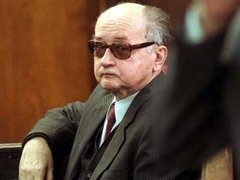
“It's biology. Those who remember are dying, and the young are brainwashed by black-and-white versions of history which, in reality, is multi-coloured, like life".
 
 ... observed recently by Poland's Jaruzelski (its last communist leader) pictured here in court at 86. He was commenting on why Poles don't seem to be interested in his take on the country's liberalization history and his role in it.

Some 25 years earlier, Jaruzelski imposed martial law, initiating a brutal 19-month crackdown on the pro-democracy Solidarity trade-union movement, an event which apparently disturbed Pope John Paul II (himself a pole) sufficiently enough to prompt a visit. The poignancy of the moment captured in the iconic photo below is palpable.

29 October 2009

... the inner music that words make


"Life is a moderately good play with a badly written third act".  

     ... Truman Capote (1924-84)

28 October 2009

"The only way you can control people is to lie to them" - L.Ron Hubbard, Journal of Scientology


Old Mother Hubbard
Went to the cupboard,
To give the poor dog a bone:
When she came there,
The cupboard was bare,
And so the poor dog had none.


This wonderful dog
Was Dame Hubbard's delight,
He could read, he could dance,
He could sing, he could write;
She gave him rich dainties
Whenever he fed,
And erected this monument
When he was dead.

25 October 2009

Capucine's complaint


"Men look at me like I'm a suspicious-looking trunk, and they're customs agents".

14 October 2009

La Vallée d'Obermann


Liszt a few months before his death. Photo by Nadar
 This is Franz Liszt (1811-86) seemingly larger than life, photographed at 74, warts and all, a few months before he died. In contrast the younger Liszt pictured below as he appeared in his prime at 47 (1858). In the time between, this remarkable man was transformed from a renowned brilliant pianist, and an important and influential composer, adulated everywhere he went, to a disconsolate person increasingly plagued with feelings of desolation, despair and death occasioned by a period of severe catastrophes in his private life. Music critic Robert Cummings writes of Liszt: "he was the only contemporary whose music Richard Wagner (1813-3) gratefully acknowledged as an influence upon his own. His lasting fame was an alchemy of extraordinary digital ability — the greatest in the history of keyboard playing — an unmatched instinct for showmanship, and one of the most progressive musical imaginations of his time. Hailed by some as a visionary, reviled by others as a symbol of empty Romantic excess, Franz Liszt wrote his name across music history in a truly inimitable manner”.

... Liszt in his prime (1858)


Perhaps Liszt’s “La Vallée d'Obermann” is as good an example as any of the man’s musical legacy, arguably the most profound work in an extraordinary collection of piano works entitled “Années de Pèlerinage” apparently initially inspired by scenes or moods associated with Liszt's travels with his one-time lover, Marie d'Agoult (a popular writer) throughout Switzerland and Italy during the period 1835-39, but in gestation for some 20 years before publication. This piece usually runs close to fifteen minutes and is the longest in the set. A quotation from Byron prefaces the music:

"Could I embody and unbosom now that which is most within me --could I wreak my thoughts upon expression, and thus throw soul, heart, mind, passions, feelings, strong or weak, all that I would have sought, and all I seek, bear, know, feel and yet breathe --into one word; and that one word were Lightning, I would speak; but as it is, I live and die unheard, with a most voiceless thought, sheathing it as a sword”.


... the great maestro


According to recent biographical research, Liszt in later life resisted hearing his Vallée d'Obermann. Apparently whenever a student brought the piece to play he declined to hear it ... "his music seemed to be burdened with memories for him, some too painful to bear".

There exists a superb recording of the work in a remarkable live concert performance (Carnegie Hall, 1966) by a celebrated virtuoso pianist which subtly captures the wonderful essence of the work, its power, deep pathos, and sheer majesty. It is fascinating because due to the exemplary skill and mature muscianship of the artist, it almost seems like a surreal time warp sound-bite from somewhere in the distant past, conceivably conveyed directly and serendipitously from the great master himself:

http://www.youtube.com/watch?v=9p1qK57H_6k&feature=g-all-u 

05 October 2009

"I am opposed to having the eagle put its talons on any other land"


"I wanted the American eagle to go screaming into the Pacific ...Why not spread its wings over the Philippines, I asked myself? ... I said to myself, Here are a people who have suffered for three centuries. We can make them as free as ourselves, give them a government and country of their own, put a miniature of the American Constitution afloat in the Pacific, start a brand new republic to take its place among the free nations of the world. It seemed to me a great task to which we had addressed ourselves. But I have thought some more, since then, and I have read carefully the treaty of Paris which ended the Spanish-American War, and I have seen that we do not intend to free, but to subjugate the people of the Philippines. We have gone there to conquer, not to redeem. It should, it seems to me, be our pleasure and duty to make those people free, and let them deal with their own domestic questions in their own way. And so I am an anti-imperialist. I am opposed to having the eagle put its talons on any other land".

  ... Mark Twain (1835-1910) describes [in 1900] his political awakening from being "a red-hot imperialist'' in the context of the Philippine-American War.  

29 September 2009

"Wait for me, Ellen: No one ever loved you as I love you!"

 War is cruelty, and you cannot refine it
"Yet one guesses that there was something more than an accelerating Catholic fanaticism in her resolute and zealous devotion. She was perhaps trying to expiate a little the horrors and griefs of Georgia, and her son's dedication to the priesthood was perhaps the price paid by his father for the reckless elation of the March to the Sea. In the remarkable painting of Ellen [pictured below] by G.P.A. Healy, the cross that hangs on her bosom, unobtrusive though it is at first sight, comes inevitably, as one looks, to draw attention as the center of the picture.


Ellen died in 1888. When her husband was called to her bedside, he came running upstairs, calling out, 'Wait for me, Ellen: No one ever loved you as I love you!'. He fell immediately after her death into one of his abysmal depressions and survived her only three years. He died in February, 1891; he had collapsed just after his 71st birthday, which he had spent in the room in which Ellen had died. He had been sitting in a rocking chair in front of the fire, rereading 'Great Expectations'."


... Edmund Wilson (1895-1972)  comments about William Tecumseh Sherman (1820-91) and wife Ellen. "Patriotic Gore"

03 September 2009

Miss Mary who?


Clear evidence indicates Mary Jo Kopechne died an agonizing cruel death. John N. Farrar, a scuba diver with the Edgartown Rescue Squad which recovered the woman's body from an upside-down vehicle in eight feet of chilly water, testified she most likely stayed alive in an air pocket for several hours:

"Farrar thrust himself through the open window and into the car. Looking up, he found the body of a young woman. Her head was cocked back, her face pressed into the footwell. Both hands gripped the front edge of the back seat to hold herself in conformity with its upholstered contours. It was not the position assumed by a person knocked unconscious by the impact of a crash, Farrar said. "If she had been dead or unconscious, she would have been prone, sinking to the bottom or floating on top. She definitely was holding herself in a position to avail herself of the last remaining air that had to be trapped in the car.
Farrar took hold of the woman's thigh, and as soon as he touched the body he knew she was dead; the flesh in his hand was hard as wood. "Instead of life-saving, I realized I was now evidence-gathering," Farrar said. "Because I was the only person who would be able to observe this situation, it behooved me to pay attention to what I saw underwater to be able to report it."
(Grand jury testimony, 1969)

Ted Kennedy (1932-2009) who had driven the car off a small bridge in the middle of that fateful night in 1969 and had managed to free himself and swim to safety, abandoned the scene and his hapless trapped 28 year old "companion". Inconceivably, he didn't call for emergency help. Instead apparently, he squandered precious seconds, minutes, and hours conferring with Kennedy family operatives as survival chances for Mary Jo ebbed, and then went to bed. He only reported the mishap to authorities the next morning, some 11 hours after it happened, by which time the upside down car had been discovered. When he finally completed an accident report, he didn’t even know her name, referring to her simply as “Miss Mary ___.”

Followers

Blog Archive