18 January 2008

Frivolous "love" and double jeopardy


We didn't find her - she found us.
She sniffed us out.
She sat there
Slightly filthy with erotic mystery.
I saw the dreamer in her
Had fallen in love with me and she did not know it.
That moment the dreamer in me
Fell in love with her, and I soon knew it.
Ted Hughes (1930-98)

This woman, Assia Wevil, killed herself (gas) in a suicide that made sure that her young daughter by Hughes died with her, declaring in a suicide note she simply couldn't leave little Shura behind, explaining: "She's too old to be adopted."

17 January 2008

The essence of "left" versus "right".


Pierre-Simon Laplace (1749-1827), one of the greatest scientists of all time, sometimes referred to as the "French Newton" or "Newton of France", with a natural phenomenal mathematical faculty possessed by none of his contemporaries, remarkably propounded the idea of black holes over 200 years ago.

However his notions of public office were not so profound. The great man's very short tenure as Minister of the Interior was terminated abruptly by Napoleon (1769-1821) with the following insightful practical assessment:


"Geometrician of the first rank, Laplace was not long in showing himself a worse than average administrator; since his first actions in office we recognized our mistake. Laplace did not consider any question objectively: he sought subtleties everywhere, only conceived problems, and finally carried the spirit of "hair-splitting" into the administration".

16 January 2008

A genius ... after and before

Beethoven (1770-1827) Death Mask, Kunsthistoriches museum, Vienna.
... at 13 by an unknown Bonn master

There is controversy as to whether this was done before the autopsy or after ... at any rate it was apparently carried out two days after Beethoven's death. The resemblance to his depiction as a child in a contemporary portrait is remarkable. Life’s toll registered in the death mask itself is intensely profound.


04 January 2008

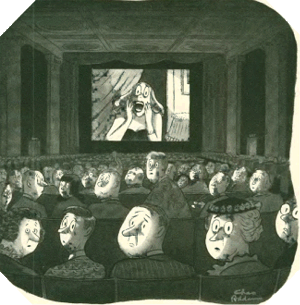
Taking in a movie ...


“A lot of people [are] in the dark sharing something that can’t be put into words. And since all of life is basically not mentioning the main thing - that we’re going to die – we’re used to the idea of something bigger than anything going on, but unspoken.” … observed by film director Mike Nichols (b.1931) about movies.

10 December 2007

Bergman confesses ...


Confessor: My heart is void … the void is a mirror. I see my face … feel loathing and horror. My indifference to men has shut me out. I live now in a world of ghosts, a prisoner in my dreams.

Death: Yet you do not want to die.

Confessor: Yes I do.

Death: What are you waiting for?

Confessor: Knowledge.

Death: A guarantee?

Confessor: Call it what you will.Is it so hard to conceive god with one’s senses?
Why must he hide in the midst of vague promises and invisible miracles?
How are we to believe the believers when we don’t believe ourselves?
What will become of us who want to believe, but cannot?
And what of those who neither will nor can believe?
Why can’t I kill god within me?
Why does he go on living in a painful and humiliating way … a mocking reality which I cannot get rid of?


... excerpt from the movie "The Seventh Seal", Ingmar Bergman (1918-2007), director & writer. When asked about this scene in an interview late in life, Bergman commented:


"I was afraid of this enormous emptiness. But my personal view now is that when we die, we die and we go from a state of something to a state of absolute nothingness ... and I don't believe for a second that there is anything above or beyond, or anything like that ... and this makes me enormously secure."

04 December 2007

Joy´s lament


"Where joy most revels, grief doth most lament.
Grief joys, joy grieves on slender accident."

... Shakespeare (1564-1616) from Hamlet

24 November 2007

Lupe's way


“The Mexican It Girl” — spunky, beautiful, buxom, and mercurial


"To Harald, may God forgive you and forgive me too but I prefer to take my life away and our baby's before I bring him with shame or killing him, Lupe."


.... suicide note (1944), actress Lupe Velez, age 36.

22 November 2007

The chaos of passion


"It is better for people to be like the beasts ... they should be more intuitive; They should not be too conscious of what they are doing while they are doing it".

 ... Albert Einstein (1879-1955)

11 November 2007

Chopin's lover

There’s an old adage (attributed to Herodotus) that says “a man calumniated is doubly injured—first by him who utters the calumny, and then by him who believes it". Certainly George Sand (1804-76) could be counted amongst those whose reputation has suffered such calumny both for her work and probably more for her relationship with Chopin. In her own time, she was lionized for her writings which have since fallen far short of being considered classics today even though her main subject was love (“All novels are love stories” she remarked), and her persistent theme the legal inequities for women in marriage. She wrote numerous novels (among them Indiana, Lelia, and Consuelo) as well as numerous plays, autobiography, political essays (Bakunin urged Marx to read her), travel books, journals and copious brilliant letters, the most celebrated to Flaubert, with whom she corresponded for years. Her admirers included Balzac, Turgenev, Dostoevsky, Margaret Fuller, Walt Whitman, Elizabeth Barrett Browning, George Eliot and Charlotte Bronte. The last three thought her the greatest French stylist of her time.

Sand’s affair with Chopin, a younger man, was as unconventional at the time as it was illicit in which as a woman she brazenly approximated to equality with men, in social dignity and in public responsibility. Edouard Grenier (1819-1901), a contemporary French poet observed of her [pictured here in 1864 at age 60, some 15 years after Chopin's death]:

"She was short and stout, but her face attracted all my attention, the eyes especially. They were wonderful eyes, a little too close together, it may be, large, with full eyelids, and black, very black, but by no means lustrous; they reminded me of unpolished marble, or rather of velvet, and this gave a strange, dull, even cold expression to her countenance. Her fine eyebrows and these great placid eyes gave her an air of strength and dignity which was not borne out by the lower part of her face. Her nose was rather thick and not over shapely. Her mouth was also rather course and her chin small. She spoke with great simplicity, and her manners were very quiet".

A not so flattering assessment was proffered by Charles Baudelaire (1821-67), another remarkable French poet of the time who started the symbolist movement:

"She is stupid, heavy and garrulous. Her ideas on morals have the same depth of judgment and delicacy of feeling as those of janitresses and kept women.... The fact that there are men who could become enamoured of this slut is indeed a proof of the abasement of the men of this generation."

10 November 2007

... a celebration of conviviality

If you want my apartment,
sleep in it
but let's have a clear
understanding:
the books are still free
agents.
If the rocking chair's arms
surround you
they can also let you go,
they can shape the air like a
body.
I don't want your rent, I want
a radiance of attention
like the candle's flame when we
eat,
I mean a kind of awe
attending the spaces between us—
Not a roof but a field of stars.

... Jane Cooper (1924-2007), American poet

30 October 2007

Hopper's world ...


In Edward Hopper’s (1882-1967) world, everyone is lost in an unending rut of office overtime, rattling El trains, cheap fluorescent diners, and lonely matinees. Everything has fallen tensely quiet. And this anxious, itchy mood haunts even the urban landscapes — perhaps half his work — in which the only person around is you, the viewer. Here every man is an island.

13 October 2007

Social inequality explained ....


So now we have it from the horse's mouth ... apparently, according to Alan Greenspan ("The Age of Turbulance: Adventures in a New World") rampant inequality is caused by lousy high schools.

24 August 2007

The Family Idiot ... on estrangement


B: Many of your friendships have ended in estrangement … why are things like that?

S: Breaking off doesn’t affect me in the least. A thing is dead – that’s all.

B: Can you tell me why it doesn’t affect you?

S: I think I did not feel a deep friendship for some of the men who were among the closer of my friends.

B: But what do you mean when you say, “I didn’t feel a deep friendship”? Who have you had a deep friendship with?

S: With some women … but generally speaking, there weren’t deep sensitive elements between the other fellows and myself.

B: Do you mean that what existed was rather a certain intellectual understanding, and that this understanding came to an end either for political reasons or for others, then everything fell to pieces?

S: Yes, that’s right.

B: The emotional bond that makes one overlook certain divergences did not remain …

S: Exactly….

B: And on the whole you always prefer the present.

S: The present is concrete and real. Yesterday is not so sharp and clear, and I’m not yet thinking of tomorrow. For me there is a preference for the present over the past. There are people who like the past better because they attribute an aesthetic or cultural value to it. I don’t. In moving into the past the present dies. It loses its value of dawning life. It still belongs to life. I can refer back to it; but it no longer possesses that quality that is given to every moment insofar as I am living it and which it loses when I am living it no more.

B: No doubt that’s why you have never found it very hard to break with your friends

S: Yes. I began a new life without them.

B: Is that because as soon as a thing belongs to the past it is really abolished for you?

S: Yes. And as for the friends who are still left to me, still living, they have to have a fresh present immediacy so as not to be continually harking back to the same one. I mustn’t see them as they were yesterday or the day before, with the same worries, the same ideas, the same ways of speaking. There has to be a change.

... Jean-Paul Sartre (S) (1905-80) in conversation with Simone de Beauvoir (B) (1908-86) in late life.

23 August 2007

Nothing lasts really. Neither happiness nor despair. Not even life lasts very long.


It's awfully easy to lie when you know that you're trusted implicitly. So very easy, and so very degrading."

... the movie "A Brief Encounter"

16 August 2007

The last of the Symbolists


"God made everything out of nothing, but the nothingness shows through."

  ... Paul Valery (1871-1945)

15 August 2007

Cynicism as an art-form ...

"la république démocratique et sociale!"

"To be stupid, and selfish, and to have good health are the three requirements for happiness; though if stupidity is lacking, all is lost'' ... Gustave Flaubert (1821-80)

Photo above: The corpses of  Paris Communards (1871)
Photo below: Memorial Plaque (Paris)
Communards' Wall at the Père Lachaise cemetery

06 August 2007

The piano player ...

''I love the piano and those who love the piano. The piano as a medium for expression is a whole world by itself. No other instrument can fill or replace its own say in the world of emotion, sentiment, poetry, imagery and fancy" ... Leopold Godowsky (1870-1938) [pictured middle]

http://www.leopoldgodowsky.com/

23 May 2007

Voltaire smiles sarcastically upon Aquinas ...


Voltaire deathmask
Voltaire’s (1694-1778) quarrel with the Catholic Church it appears was that it was a self-serving institution … a worldly body, and not of or for God. As well, the bible to Voltaire was not a divine gift or the ‘word of God’, but rather by and large a metaphor that taught some good lessons. He famously observed "if God did not exist, it would be necessary to invent him".  On the other hand for Aquinas (1225-74) the bible was a sacred doctrine whose sources are self-revelations of God to certain 'select' individuals throughout history. Aquinas apparently denied that human beings have any duty to animals and plants because they are not persons, have no 'souls' and accordingly can be used freely with impunity for consumption. He encouraged people to reproduce with irresponsible abandon without limit viewing it as a basic god-given right. His tenets are still widely believed and practiced without reservation. Voltaire viewed this elitist view of man’s place in nature as profoundly evil. It has to do with choice and action, and the tension in which choices are made which are reckless, irresponsible, suicidal, and indeed ultimately godless.


animals have no 'souls'

15 May 2007

Metaphorically speaking …


Metaphors are incredibly seductive: they effortlessly slot into the brain, allowing us to seemingly make quick sense of difficult ideas.


But we should heed Nietzsche's warning … that metaphors illuminate as they conceal:

“What, then, is truth? A mobile army of metaphors, metonyms, and anthropomorphisms—in short, a sum of human relations which have been enhanced, transposed, and embellished poetically and rhetorically, and which after long use seem firm, canonical, and obligatory to a people: truths are illusions about which one has forgotten that this is what they are; metaphors which are worn out and without sensuous power; coins which have lost their pictures and now matter only as metal, no longer as coins.”

As much as could be said of Nietzsche’s sister, seen here as a vital old woman in her late eighties, wearing granny glasses and a bonnet welcoming Hitler to the Nietzsche Archives in 1934. She was a dupe to contrived hollow tribute and apparently not a reliable custodian of her brother's legacy.

Followers

Blog Archive