14 October 2009

La Vallée d'Obermann


Liszt a few months before his death. Photo by Nadar
 This is Franz Liszt (1811-86) seemingly larger than life, photographed at 74, warts and all, a few months before he died. In contrast the younger Liszt pictured below as he appeared in his prime at 47 (1858). In the time between, this remarkable man was transformed from a renowned brilliant pianist, and an important and influential composer, adulated everywhere he went, to a disconsolate person increasingly plagued with feelings of desolation, despair and death occasioned by a period of severe catastrophes in his private life. Music critic Robert Cummings writes of Liszt: "he was the only contemporary whose music Richard Wagner (1813-3) gratefully acknowledged as an influence upon his own. His lasting fame was an alchemy of extraordinary digital ability — the greatest in the history of keyboard playing — an unmatched instinct for showmanship, and one of the most progressive musical imaginations of his time. Hailed by some as a visionary, reviled by others as a symbol of empty Romantic excess, Franz Liszt wrote his name across music history in a truly inimitable manner”.

... Liszt in his prime (1858)


Perhaps Liszt’s “La Vallée d'Obermann” is as good an example as any of the man’s musical legacy, arguably the most profound work in an extraordinary collection of piano works entitled “Années de Pèlerinage” apparently initially inspired by scenes or moods associated with Liszt's travels with his one-time lover, Marie d'Agoult (a popular writer) throughout Switzerland and Italy during the period 1835-39, but in gestation for some 20 years before publication. This piece usually runs close to fifteen minutes and is the longest in the set. A quotation from Byron prefaces the music:

"Could I embody and unbosom now that which is most within me --could I wreak my thoughts upon expression, and thus throw soul, heart, mind, passions, feelings, strong or weak, all that I would have sought, and all I seek, bear, know, feel and yet breathe --into one word; and that one word were Lightning, I would speak; but as it is, I live and die unheard, with a most voiceless thought, sheathing it as a sword”.


... the great maestro


According to recent biographical research, Liszt in later life resisted hearing his Vallée d'Obermann. Apparently whenever a student brought the piece to play he declined to hear it ... "his music seemed to be burdened with memories for him, some too painful to bear".

There exists a superb recording of the work in a remarkable live concert performance (Carnegie Hall, 1966) by a celebrated virtuoso pianist which subtly captures the wonderful essence of the work, its power, deep pathos, and sheer majesty. It is fascinating because due to the exemplary skill and mature muscianship of the artist, it almost seems like a surreal time warp sound-bite from somewhere in the distant past, conceivably conveyed directly and serendipitously from the great master himself:

http://www.youtube.com/watch?v=9p1qK57H_6k&feature=g-all-u 

05 October 2009

"I am opposed to having the eagle put its talons on any other land"


"I wanted the American eagle to go screaming into the Pacific ...Why not spread its wings over the Philippines, I asked myself? ... I said to myself, Here are a people who have suffered for three centuries. We can make them as free as ourselves, give them a government and country of their own, put a miniature of the American Constitution afloat in the Pacific, start a brand new republic to take its place among the free nations of the world. It seemed to me a great task to which we had addressed ourselves. But I have thought some more, since then, and I have read carefully the treaty of Paris which ended the Spanish-American War, and I have seen that we do not intend to free, but to subjugate the people of the Philippines. We have gone there to conquer, not to redeem. It should, it seems to me, be our pleasure and duty to make those people free, and let them deal with their own domestic questions in their own way. And so I am an anti-imperialist. I am opposed to having the eagle put its talons on any other land".

  ... Mark Twain (1835-1910) describes [in 1900] his political awakening from being "a red-hot imperialist'' in the context of the Philippine-American War.  

29 September 2009

"Wait for me, Ellen: No one ever loved you as I love you!"

 War is cruelty, and you cannot refine it
"Yet one guesses that there was something more than an accelerating Catholic fanaticism in her resolute and zealous devotion. She was perhaps trying to expiate a little the horrors and griefs of Georgia, and her son's dedication to the priesthood was perhaps the price paid by his father for the reckless elation of the March to the Sea. In the remarkable painting of Ellen [pictured below] by G.P.A. Healy, the cross that hangs on her bosom, unobtrusive though it is at first sight, comes inevitably, as one looks, to draw attention as the center of the picture.


Ellen died in 1888. When her husband was called to her bedside, he came running upstairs, calling out, 'Wait for me, Ellen: No one ever loved you as I love you!'. He fell immediately after her death into one of his abysmal depressions and survived her only three years. He died in February, 1891; he had collapsed just after his 71st birthday, which he had spent in the room in which Ellen had died. He had been sitting in a rocking chair in front of the fire, rereading 'Great Expectations'."


... Edmund Wilson (1895-1972)  comments about William Tecumseh Sherman (1820-91) and wife Ellen. "Patriotic Gore"

03 September 2009

Miss Mary who?


Clear evidence indicates Mary Jo Kopechne died an agonizing cruel death. John N. Farrar, a scuba diver with the Edgartown Rescue Squad which recovered the woman's body from an upside-down vehicle in eight feet of chilly water, testified she most likely stayed alive in an air pocket for several hours:

"Farrar thrust himself through the open window and into the car. Looking up, he found the body of a young woman. Her head was cocked back, her face pressed into the footwell. Both hands gripped the front edge of the back seat to hold herself in conformity with its upholstered contours. It was not the position assumed by a person knocked unconscious by the impact of a crash, Farrar said. "If she had been dead or unconscious, she would have been prone, sinking to the bottom or floating on top. She definitely was holding herself in a position to avail herself of the last remaining air that had to be trapped in the car.
Farrar took hold of the woman's thigh, and as soon as he touched the body he knew she was dead; the flesh in his hand was hard as wood. "Instead of life-saving, I realized I was now evidence-gathering," Farrar said. "Because I was the only person who would be able to observe this situation, it behooved me to pay attention to what I saw underwater to be able to report it."
(Grand jury testimony, 1969)

Ted Kennedy (1932-2009) who had driven the car off a small bridge in the middle of that fateful night in 1969 and had managed to free himself and swim to safety, abandoned the scene and his hapless trapped 28 year old "companion". Inconceivably, he didn't call for emergency help. Instead apparently, he squandered precious seconds, minutes, and hours conferring with Kennedy family operatives as survival chances for Mary Jo ebbed, and then went to bed. He only reported the mishap to authorities the next morning, some 11 hours after it happened, by which time the upside down car had been discovered. When he finally completed an accident report, he didn’t even know her name, referring to her simply as “Miss Mary ___.”

24 August 2009

personification

Our imagination is stretched to the utmost, not, as in fiction, to imagine things which are not really there, but just to comprehend those things which are there.


"I'm jealous of the old generation that has social skills and role models instead of TV and computer screens!"

Figure of speech in which human characteristics are attributed to an abstract quality, animal, or inanimate object. An example is "The Moon doth with delight / Look round her when the heavens are bare" (William Wordsworth, "Ode: Intimations of Immortality from Recollections of Early Childhood," 1807). Another is "Death lays his icy hand on kings" (James Shirley, "The Glories of Our Blood and State," 1659). Personification has been used in European poetry since Homer and is particularly common in allegory; for example, the medieval morality play Everyman (c. 1500) and the Christian prose allegory Pilgrim's Progress (1678) by John Bunyan contain characters such as Death, Fellowship, Knowledge, Giant Despair, Sloth, Hypocrisy, and Piety. Personification became almost an automatic mannerism in 18th-century Neoclassical poetry, as exemplified by these lines from Thomas Gray's "An Elegy Written in a Country Church Yard": Here rests his head upon the lap of earthA youth to Fortune and to Fame unknown:Fair science frowned not on his humble birth,And Melancholy marked him for her own.

truths are illusions about which one has forgotten that this is what they are

- most media are dominated by acting ... people watching people act ... a flimsy surrogate for the real thing, at best.
- idiosyncracies of the actor; certain mannerisms contrived or inherent
may intrigue the viewer but are an adulteration of the “truth”, the thing
immitated.
- there’s a gap between a sense of what is real and what is contrived
- the gap in itself is innocuous , unless it shrinks to nothing, as the act
becomes reality in peoples mind

http://www.u.arizona.edu/~kamtekar/papers/personification.pdf


[Note: this entry is a work in process ... exploring the concept of personification as all perversive/Plato's identification of it/dramatic arts and acting/social interaction and communication/language structure and evolution/peer pressure behaviour/etc]

06 August 2009

terrible passions in red and green ...

Night Café

"I have tried to express the terrible passions of humanity by means of red and green" van Gogh wrote. Yellow walls give on to blood-red walls that lead to an obtrusive green ceiling, and lining the walls are the locals at the bar tables, hunched over in late-night stupor. Lamps hang from the ceiling, surrounded by Vincent's wheels of curving yellow strokes. A stark black and white clock looms in the background, impossible to miss. It is almost a quarter past midnight in this desolate scene.

"Night Café" painted in Arles in 1888 is, in the artist's own words, "…one of the ugliest I have ever done" ... a collection of clashing colors in the dreariest atmosphere with fully two-thirds of the painting the floor of the café, executed in sulphuric yellow with exaggerated lines of perspective that yank the eye into the painting. A green billiard table, outlined in heavy black, stops us cold. Beside the table stands a figure in a light-colored coat, staring out at us without expression, perhaps the cafe owner for whom allegedly the painting was made to pay off a debt.

A case of superficial vitality ...

"He projected a superficial vitality; both women and men were drawn to him by that alone. Closely observed, however, one sensed a secret fatigue, a lack of any real optimism. His wife was severely aware of it, and why not? She was its principal cause."

      ... Music For Chameleons, Truman Capote (1924-84)

04 August 2009

Rememberance of things past and the chaos of clear ideas ...

When a drowsy, dreamy influence seems to hang over sessions of sweet silent thought, and to pervade every nook and cranny of a mind in repose, I marvel at the vividness of  early childhood memories, and the immediacy of their intricately woven sensations ... a chaos of clear ideas that form the very essence of being and consciousness. The recall, for example, of summer languidness on the last day of a school year in an empty classroom, windows flung open to the enticing bright sunny freedom of a cooling breeze, mingled with the sharp anguished lonely dismay of sudden release from routine. These memories linger as vivid mood pictures imbedded in the mind, involving feelings which in manifold variety shape individual personalities. The subtle nuances and flavors of a whole culture and way of life long past, essentially permanent archetypes of human character and experience, can and do haunt the cavernous corridors of a vast unconsciousness  curiously shaping en masse the character of a whole community.


uncanny musical genius


Czech composer Dvorak (1841-1904) [pictured with his wife in 1886] captured with uncanny musical genius the sense of such a time past … wide open country settings languishing under vast cathedralic canopies of  pale blue skies and billowy wisps of pure white clouds, coalescing with the rapturous intricacies of simple rural life. His music conveys a sense of this bucolic past with such delicate knowing intimacy that tears might easily well up in one's eyes … for there is profound sadness in this music, a compelling intuition that Dvorak was driven to capture a thing of wondrous beauty knowing full well it was fleeting:
 
"https://www.youtube.com/embed/PbNWuTC4n_8"
 
This was a time of ancestors long gone and forgotten, their remnants buried in little country church cemeteries, slowly succumbing to nature’s inexorable disintegrating forces:
nature’s inexorable disintegrating forces:

07 July 2009

Gadgets and copycats

Nagasaki 9Aug45
"Fat Man"
US B-29 Superfortress Bockscar and crew

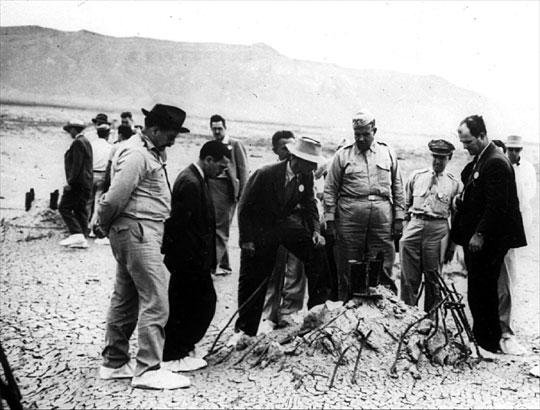
The atomic bomb "Fat Man" was dropped on Nagasaki 9Aug45 by the US B-29 Superfortress Bockscar [pictured with crew below]. It was modeled on "the gadget", the very first experimental atomic bomb detonated just a month before at the so-called "Trinity test"* in Socorro, New Mexico. The mushroom cloud resulting from the nuclear explosion over Nagasaki [above] rose 18 km (11 mi, 60,000 ft) into the air from the hypocenter. 80,000 were killed, half on the first day.


"Joe-1"


So porous was the security at the Manhatten Project where all the intense work was done to accomplish the deed, that the first Soviet bomb, RDS-1 (a.k.a. "Joe-1" in reference to Stalin) was almost a direct copy, even in its external shape, of the US-developed Fat Man bomb. It was test-exploded a mere 4 years after the Nagasaki drop in Aug49.


Theodore Hall (1925-99), one of several physicists working at the time on the Manhattan Project eventually fessed up some 50 years later to divulging critical intelligence to the Soviets. He believed strongly (along with others, some caught much earlier, and executed for their deemed treachery) that an American monopoly on nuclear weapons was dangerous. He explained it this way in 1998, just before he died:

"I decided to give atomic secrets to the Russians because it seemed to me that it was important that there should be no monopoly, which could turn one nation into a menace and turn it loose on the world as ... as Nazi Germany developed. There seemed to be only one answer to what one should do. The right thing to do was to act to break the American monopoly".


-------------------------------------------------------------------------------------
*  This rare photo was taken at ground zero of the Trinity test site, after the bombing of Hiroshima and Nagasaki, and some time after the actual test. Oppenheimer, the so-called father of the atomic bomb, appears at the center in a light colored hat:

The ruins of the noblest man


This only known photograph* of Chopin (1810-49) at age 39 taken by Bisson in 1849 clearly reveals the ravages of the degenerative stages of tuberculosis which took his life only a few months later. Despite the carefully posed positioning, it is quite apparent his face is bloated from the inflammatory effects of his illness, and his whole countenance is rather pathetic and tragically sad. It used to be thought that this celebrated daguerreotype was taken in the summer of 1849, in the  Paris offices of Chopin’s publisher Maurice Schlesinger, and that date appears in many of the major iconographies of Chopin. We now know it to have been taken by Bisson in his atelier at 65 rue Saint-Germain l’Auxerrois toward the end of 1847, not long after Chopin’s break with George Sand. During Chopin’s lifetime it belonged to Schlesinger’s private collection and subsequently to the firm of Breitkopf and Härtel in Leipzig. It was later acquired by the Chopin National Institute in Warsaw. The original daguerreotype was destroyed during World War II. What we have today is a photograph of that daguerreotype made sometime before 1939.

Pianist and composer Ignaz Moscheles (1794-1870), a music contemporary, provided a precise description of him in better days:

"He was of slim frame, middle height [apparently 100lbs/5'7"]; fragile but wonderfully flexible limbs, delicately formed hands, very small feet, an oval, softly outlined head, a pale transparent complexion, long silken hair of a light chestnut color, parted on one side, tender brown eyes, intelligent rather than dreamy, a finely-curved aquiline nose, a sweet subtle smile, graceful and varied gestures."  

Curiously, the death mask below, inflammation clearly vitiated in mortal suspension, ironically provides perhaps a more realistic semblance of what the man must have looked like in Paris high society at the pinnacle of his fame as a strange, wonderful composer and musician for the piano, capturing a delicacy and a certain sublime aristocratic bearing that people of his day certainly witnessed, an essence of which pervades his works for which he is very much exalted today as indeed he was in his own time.


"Thou art the ruins of the noblest man
That ever lived in the tide of time".


 http://www.youtube.com/watch?v=gHjHzX79sdc&feature=related


*NOTE: Apparently this is a 2nd Chopin photograph (c.1847), sourced at the Fryderyk Chopin Society, Warsaw. I cannot vouch for its verity.

04 July 2009

A grief observed ...


Here the whole world (stars, water, air,
And field, and forest, as they were
Reflected in a single mind)
Like cast off clothes was left behind
In ashes, yet with hopes that she,
Re-born from holy poverty,
In lenten lands, hereafter may
Resume them on her Easter Day.


  ... C. S. Lewis (1898-1963)

12 April 2009

... the living and the dead

the lonely churchyard on the hill

"A few light taps upon the pane made him turn to the window. It had begun to snow again. He watched sleepily the flakes, silver and dark, falling obliquely against the lamplight. The time had come for him to set out on his journey westward. Yes, the newspapers were right: snow was general all over Ireland. It was falling on every part of the dark central plain, on the treeless hills, falling softly upon the Bog of Allen and, farther westward, softly falling into the dark mutinous Shannon waves. It was falling, too, upon every part of the lonely churchyard on the hill where Michael Furey lay buried. It lay thickly drifted on the crooked crosses and headstones, on the spears of the little gate, on the barren thorns. His soul swooned slowly as he heard the snow falling faintly through the universe and faintly falling, like the descent of their last end, upon all the living and the dead".


... James Joyce (1882-1941) "The Dead" Dubliners

09 April 2009

The American Dream

Guiseppe Zangara's failed attempt to assassinate U.S. President-elect Franklin D. Roosevelt (1882-1945) demonstrated how the frustrations of financial misfortune in the Great Depression (1929 - early 1940s ... the longest, most widespread, and deepest depression of the 20th century) could lead to desperate and mindless acts of violence.

Zangara was born in 1900 in Italy. His mother died when he was two and his father remarried to a widow with six daughters. The expanded family, already poor, endured severe hardship and soon food became scarce. When Zangara was six his father took him out of school and put him to work digging deep ditches and hauling heavy bricks and stones. The strenuous work and poor nourishment was a contributing factor to his slight build and a burning stomach ache, and the pain began to drive him mad. His entire life began to revolve around his stomach pain and his health.

Zangara hated his father and blamed him for the horrible stomach pain he endured. He believed that his father should be punished, but the lousy capitalists in Italy were too busy to help him. Thus he developed a deep hatred for everyone who was rich or worked in government. Driven mad with pain, he came to believe that if he could kill the leader of the capitalists, his stomach pain might go away. He plotted to assassinate King Victor Emmanuel III (1869-1947), but left for the United States before carrying out his plan. He secured a job as a bricklayer in New Jersey. He and his uncle lived together for a year until his uncle married. Zangara and his new aunt did not get along well, so he moved out. He lived very frugally and saved most of his money, allowing him some freedom to travel. He traveled to Panama and California in hopes that the warmer climate would help his stomach.

Finally he moved to Miami, Florida and again was working as a brick layer. In 1926 he went to see doctors about his stomach, who removed his appendix hoping that would solve the problem. However, it did not. In 1932, as the Great Depression had started to affect him, his stomach pain grew progressively worse. He decided that if he were to assassinate President Herbert Hoover (1874-1964) the problem would be solved, because everyone said Hoover was to blame for the Depression. However, Hoover lost the presidential election to Democratic candidate, Franklin Delano Roosevelt.

On February 13, 1933, Zangara bought a .32 caliber pistol for $4 at a local drugstore, and planned to take a bus to Washington D.C. the next day. While walking to the bus station, he saw newspaper headlines reporting that President-elect Franklin Roosevelt was visiting the Miami area the next day. After giving a short talk at the Bayfront Park from the rear of a convertible car, FDR had just finished shaking hands with visiting Chicago Mayor Anton Cermak (1873-1933) [pictured here to the left of FDR] when Zangara fired upon the president. However, being only five feet tall, he was unable to see over other people, and had to stand on a wobbly folding metal chair. After the first shot,  people grabbed his arm, but he fired four more shots wildly. He missed the president-elect, but five other people were hit, including Cermak. The Chicago mayor suffered an abdominal wound [pictured below]. En route to Jackson Memorial Hospital in the presidential convertible, Cermak allegedly told FDR, “I’m glad it was me and not you, Mr. President”, words now inscribed on a plaque in Bayfront Park.
After Zangara's arrest, doctors examined him and discovered severe ulcers as the cause of his chronic pain. He was put on trial and sentenced to 84 years for injuring bystanders during his attempt to kill Roosevelt. He pleaded guilty and showed no remorse except for missing Roosevelt. Cermak's condition deteriorated and he died some three weeks after the assassination attempt. Zangara was then put on trial for his murder and was sentenced to death in the electric chair at the Florida State Penitentiary in Raiford. When he heard his sentence he yelled at the judge, "You give me electric chair. I no afraid of that chair! You're one of capitalists. You is crook man too. Put me in electric chair. I no care!".

On March 20, Zangara walked to the electric chair unaided and not afraid. He yelled and cursed at the guards. After a shroud was placed over his head, he screamed, "Lousy capitalists! No picture! Capitalists! No one here to take my picture. All capitalists lousy bunch of crooks. Go ahead. Push the button!" The guard pulled the switch and Zangara was no more. He had no family or friends present, and his unclaimed remains were buried in an unmarked grave at the prison.
08 April 2009

Art for art's sake ...


"Only through art can we get outside of ourselves and know another's view of the universe which is not the same as ours and see landscapes which would otherwise have remained unknown to us like the landscapes of the moon. Thanks to art, instead of seeing a single world, our own, we see it multiply until we have before us as many worlds as there are original artists...And many centuries after their core, whether we call it Rembrandt or Vermeer, is extinguished, they continue to send us their special rays".
 ... Marcel Proust (1871-1942)

08 March 2009

the surest poison is time


"From the point of sensuous experience, seen from the streets and markets and the haunts of pleasure and gain, the estimate of age is low, melancholy, and skeptical. Frankly face the facts, and see the result. Tobacco, coffee, alcohol, hashish, prussic acid, strychnine, are weak dilutions: the surest poison is time. This cup, which Nature puts to our lips, has a wonderful virtue, surpassing that of any other draught. It opens the senses, adds power, fills us with exalted dreams, which we call hope, love, ambition, science: especially, it creates a craving for larger draughts of itself. But they who take the larger draughts are drunk with it, lose their stature, strength, beauty, and senses, and end in folly and delirium. We postpone our literary work until we have more ripeness and skill to write, and we one day discover that our literary talent was a youthful effervescence which we have now lost".

  ... Ralph Waldo Emerson (1803-82), “Old Age” in The Atlantic 1862.

19 February 2009

Yeah .. bring 'em on!


"In small areas, before small electorates, a first-rate man occasionally fights his way through, carrying even the mob with him by force of his personality. But when the field is nationwide, and the fight must be waged chiefly at second and third hand, and the force of personality cannot so readily make itself felt, then all the odds are on the man who is, intrinsically, the most devious and mediocre — the man who can most easily adeptly disperse the notion that his mind is a virtual vacuum.

The Presidency tends, year by year, to go to such men. As democracy is perfected, the office represents, more and more closely, the inner soul of the people. We move toward a lofty ideal. On some great and glorious day the plain folks of the land will reach their heart's desire at last, and the White House will be adorned by a downright moron."

  ... H.L. Mencken (1880-1956)

11 February 2009

Raunchiness par excellence!


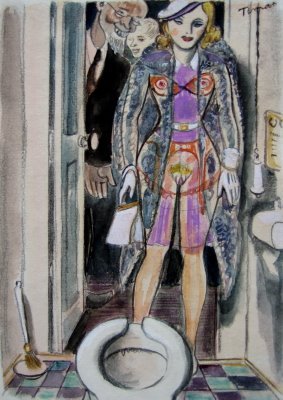
American writer Henry Miller (1891-1980) [pictured here in the mid 30s] celebrated Bohemian ex-pat life in Paris in the early 1900’s, as deliciously depicted in such novel-memoirs as Tropic of Cancer.

Another ex-pat in Paris at the time was the Hungarian artist Emeric Timar (1898-1950) who was inspired enough by Miller’s accounts to create expressionist lithographs with a surrealist edge capturing the raw sexuality that permeates pretty well everything Miller wrote. They were made in 1949.


Presented here juxtaposed with the sombre looking Miller is Timar's “The American Girl” in water colour. Miller apparently disliked them, perhaps because for the title page vignette Timar drew Miller with a penis for a nose.

01 February 2009

The Union endures!


“… there is a physical difference between the white and black races, which … will forever forbid the two races living together upon terms of social and political equality”

Abraham Lincoln (1809-65)

The sedge has wither’d from the lake, and no birds sing


"Notwithstanding your happiness and your recommendations, I hope I shall never marry: though the most beautiful creature were waiting for me at the end of a journey or a walk; though the carpet were of silk, and the curtains of the morning clouds, the chairs and sofas stuffed with cygnet’s down, the food manna, the wine beyond claret, the window opening on Winandermere, I should not feel, or rather my happiness should not be, so fine; my solitude is sublime—for, instead of what I have described, there is a sublimity to welcome me home; the roaring of the wind is my wife; and the stars through the window-panes are my children; the mighty abstract Idea of Beauty in all things, I have, stifles the more divided and minute domestic happiness.... I feel more and more every day, as my imagination strengthens, that I do not live in this world alone, but in a thousand worlds. No sooner am I alone, than shapes of epic greatness are stationed around me, and serve my spirit the office which is equivalent to a King’s Body-guard: “then Tragedy with scepter’d pall comes sweeping by:” according to my state of mind, I am with Achilles shouting in the trenches, or with Theocritus in the vales of Sicily; or throw my whole being into Troilus, and, repeating those lines, “I wander like a lost soul upon the Stygian bank, staying for waftage,” I melt into the air with a voluptuousness so delicate, that I am content to be alone.”

  ...  John Keats (1795-1821) from a letter written 29Oct1818 to his brother George. Keats was 23.

30 January 2009

The dreadful face of unfeeling ignorance or evil or both

"the negro might justly and lawfully be reduced to slavery for his benefit"


In March of 1857, a case before the United States Supreme Court, led by Chief Justice Roger B. Taney [pictured in 1855 at 78], concerned Dred Scott, a slave who had appealed to the Court in hopes of being granted his freedom. Taney wrote in a majority opinion that the framers of the Constitution believed that blacks "had no rights which the white man was bound to respect; and that the negro might justly and lawfully be reduced to slavery for his benefit. He was bought and sold and treated as an ordinary article of merchandise and traffic, whenever profit could be made by it”. Referring to the language in the Declaration of Independence that includes the phrase, "all men are created equal", Taney maintained that "it is too clear for dispute, that the enslaved African race were not intended to be included, and formed no part of the people who framed and adopted this declaration. . . ."

Followers

Blog Archive