25 November 2008

Tender is the Butterfly


"… his talent was as natural as the pattern that was made by the dust on a butterfly’s wings. At one time he understood it no more than the butterfly did and he did not know when it was brushed or marred. Later he became conscious of his damaged wings and of their construction and he learned to think and could not fly any more because the love of flight was gone and he could only remember when it had been effortless."

   ... excerpt from A Moveable Feast (posthumus 1964 edition),  Hemingway (1899-1961) on Fitzgerald (1896-1940)

20 November 2008

The Moving Finger writes ...


The Moving Finger writes; and, having writ,
Moves on: nor all thy Piety nor Wit
Shall lure it back to cancel half a Line,
Nor all thy Tears wash out a Word of it.

 ... Omar Khayyam (1048-1131), Persian poet

02 November 2008

All About George


"Dear World, I am leaving because I am bored. I feel I have lived long enough. I am leaving you with your worries in this sweet cesspool. Good luck."

   ... George Sanders (1906-72), actor [suicide note]

27 September 2008

Forrest Gump in drag … with red lipstick


If this photo (above right) had been doctored (as the film clip inset above left from the movie Forrest Gump) it would be an amusing lark perhaps found in the back pages of a cheap tabloid magazine .. certainly not in the mainstream media, even momentarily. But it’s there alright, and real … even surreal, but soon (hopefully) to be relegated to the dust bin of historical mementoes of the fleeting bravado of a naïve mind suddenly thrust into the public limelight, totally mesmerized while incapable of entertaining a single serious thought.

13 August 2008

A clean, well-lighted place


"It was the light of course but it is necessary that the place be clean and pleasant. You do not want music. Certainly you do not want music. Nor can you stand before a bar with dignity although that is all that is provided for these hours. What did he fear? It was not a fear or dread. It was a nothing that he knew too well. It was all a nothing and a man was a nothing too. It was only that and light was all it needed and a certain cleanness and order. Some lived in it and never felt it but he knew it all was nada y pues nada y nada y pues nada.
Our nada who art in nada, nada be thy name thy kingdom nada thy will be nada in nada as it is in nada. Give us this nada our daily nada and nada us our nada as we nada our nadas and nada us not into nada but deliver us from nada; pues nada. Hail nothing full of nothing, nothing is with thee.
He smiled and stood before a bar with a shining steam pressure coffee machine.
"What's yours?" asked the barman.
"Nada."
"Otro loco mas," said the barman and turned away.
"A little cup," said the waiter. The barman poured it for him.
"The light is very bright and pleasant but the bar is unpolished" the waiter said.
The barman looked at him but did not answer. It was too late at night for conversation.
"You want another copita?" the barman asked.
"No, thank you," said the waiter and went out.
He disliked bars and bodegas. A clean, well-lighted cafe was a very different thing. Now, without thinking further, he would go home to his room. He would lie in the bed and finally, with daylight, he would go to sleep. After all, he said to himself, it's probably only insomnia. Many must have it."

 ... Ernest Hemingway (1899-1961)
01 July 2008

The ultimate defensive weapon ... a screwdriver.


Asked in a closed Senate hearing room "whether three or four men couldn't smuggle units of an [atomic] bomb into New York and blow up the whole city",Oppenheimer (1904-67)responded, "Of course it could be done, and people could destroy New York." When a startled senator then followed by asking, "What instrument would you use to detect an atomic bomb hidden somewhere in a city?" Oppenheimer quipped, "A screwdriver" [to open each and every crate or suitcase]. There was no defense to nuclear terrorism and he felt there never would be. ... "

... American Prometheus: The Triumph and Tragedy of J Robert Oppenheimer"

29 June 2008

A Darwinian take on the evolution of new ideas

Max Planck (1858-1947) pictured here presenting Albert Einstein (1879-1955) the Max-Planck medal in Berlin (1929). whose prescient and revolutionary notion of “quanta” arguably launched the whole mystical, radically new and innovative field of Quantum Mechanics, had this to say about the Darwinian-like evolution of new ideas:

"A new scientific truth does not triumph by convincing its opponents and making them see the light, but rather because its opponents eventually die and a new generation grows up that is familiar with it."

Einstein never wholly embraced the implications of this new field of physics, Quantum Mechanics ("God does not play dice"), curiously bearing out Planck’s observation.

It’s a sad historical note that Planck’s second son to whom he had been particularly close was implicated by the Nazis in the failed assassination plot of Hitler and died a horrible death at the hands of the Gestapo. Planck died a broken old man two years later at 89.

15 June 2008

The smudged remnant of a famous name and the rage of a great mind!


Beethoven’s original title page of his monumental Eroica symphony bears the evidence. The great composer's assistant Ferdinand Ries tells the story in his contemporary biography of Beethoven:

"In writing this symphony Beethoven had been thinking of Bonaparte, but Bonaparte while he was First Consol. At that time Beethoven had the highest esteem for him and compared him to the greatest consuls of ancient Rome. Not only I, but many of Beethoven's closer friends, saw this symphony on his table, beautifully copied in manuscript, with the word 'Bonaparte' inscribed at the very top of the title-page and 'Ludwig van Beethoven' at the very bottom. …I was the first to tell him the news that Bonaparte had declared himself Emperor, whereupon he broke into a rage and exclaimed, 'So he is no more than a common mortal! Now, too, he will tread under foot all the rights of man, indulge only his ambition; now he will think himself superior to all men, become a tyrant!' Beethoven went to the table, seized the top of the title-page, tore it in half and threw it on the floor. The page had to be re-copied and it was only now that the symphony received the title 'Sinfonia eroica'."

A particular trauma for Beethoven occurred during this period in 1809, when the attacking forces of Napoleon bombarded Vienna. Beethoven, very worried that the noise would destroy what remained of his hearing, reportedly hid in the basement of his brother's house, covering his ears with pillows.

11 March 2008

There is always something wrong ...


We can get a pretty good impression of what this man was like from the way he was excellently portrayed in the popular movie Amadeus. It’s probably safe to say that, more than anything, it was his careful, intelligent nurturing of his son Mozart (1756-91) as a child prodigy that was responsible for providing the world the benefit of this supremely gifted composer's exquisite profound genius. The following laconic missive to his daughter just a few months before he died at 68 captures the practical essence of the man:

“You always want to hear that I am in excellent heath. You are not allowing for the difference between an old man and a young man. I don’t have time to write a long letter, suffice it to say that for an old man there is no such thing as excellent health. There is always something wrong, and an old man declines just as youth grows and prospers. In short, one must mend as long as there is something to mend” (24Feb1787).

18 January 2008

Frivolous "love" and double jeopardy


We didn't find her - she found us.
She sniffed us out.
She sat there
Slightly filthy with erotic mystery.
I saw the dreamer in her
Had fallen in love with me and she did not know it.
That moment the dreamer in me
Fell in love with her, and I soon knew it.
Ted Hughes (1930-98)

This woman, Assia Wevil, killed herself (gas) in a suicide that made sure that her young daughter by Hughes died with her, declaring in a suicide note she simply couldn't leave little Shura behind, explaining: "She's too old to be adopted."

17 January 2008

The essence of "left" versus "right".


Pierre-Simon Laplace (1749-1827), one of the greatest scientists of all time, sometimes referred to as the "French Newton" or "Newton of France", with a natural phenomenal mathematical faculty possessed by none of his contemporaries, remarkably propounded the idea of black holes over 200 years ago.

However his notions of public office were not so profound. The great man's very short tenure as Minister of the Interior was terminated abruptly by Napoleon (1769-1821) with the following insightful practical assessment:


"Geometrician of the first rank, Laplace was not long in showing himself a worse than average administrator; since his first actions in office we recognized our mistake. Laplace did not consider any question objectively: he sought subtleties everywhere, only conceived problems, and finally carried the spirit of "hair-splitting" into the administration".

16 January 2008

A genius ... after and before

Beethoven (1770-1827) Death Mask, Kunsthistoriches museum, Vienna.
... at 13 by an unknown Bonn master

There is controversy as to whether this was done before the autopsy or after ... at any rate it was apparently carried out two days after Beethoven's death. The resemblance to his depiction as a child in a contemporary portrait is remarkable. Life’s toll registered in the death mask itself is intensely profound.


04 January 2008

Taking in a movie ...


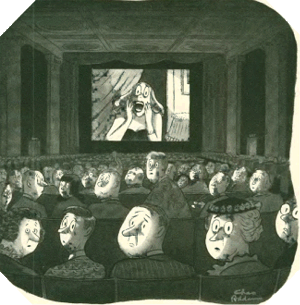
“A lot of people [are] in the dark sharing something that can’t be put into words. And since all of life is basically not mentioning the main thing - that we’re going to die – we’re used to the idea of something bigger than anything going on, but unspoken.” … observed by film director Mike Nichols (b.1931) about movies.

10 December 2007

Bergman confesses ...


Confessor: My heart is void … the void is a mirror. I see my face … feel loathing and horror. My indifference to men has shut me out. I live now in a world of ghosts, a prisoner in my dreams.

Death: Yet you do not want to die.

Confessor: Yes I do.

Death: What are you waiting for?

Confessor: Knowledge.

Death: A guarantee?

Confessor: Call it what you will.Is it so hard to conceive god with one’s senses?
Why must he hide in the midst of vague promises and invisible miracles?
How are we to believe the believers when we don’t believe ourselves?
What will become of us who want to believe, but cannot?
And what of those who neither will nor can believe?
Why can’t I kill god within me?
Why does he go on living in a painful and humiliating way … a mocking reality which I cannot get rid of?


... excerpt from the movie "The Seventh Seal", Ingmar Bergman (1918-2007), director & writer. When asked about this scene in an interview late in life, Bergman commented:


"I was afraid of this enormous emptiness. But my personal view now is that when we die, we die and we go from a state of something to a state of absolute nothingness ... and I don't believe for a second that there is anything above or beyond, or anything like that ... and this makes me enormously secure."

04 December 2007

Joy´s lament


"Where joy most revels, grief doth most lament.
Grief joys, joy grieves on slender accident."

... Shakespeare (1564-1616) from Hamlet

24 November 2007

Lupe's way


“The Mexican It Girl” — spunky, beautiful, buxom, and mercurial


"To Harald, may God forgive you and forgive me too but I prefer to take my life away and our baby's before I bring him with shame or killing him, Lupe."


.... suicide note (1944), actress Lupe Velez, age 36.

22 November 2007

The chaos of passion


"It is better for people to be like the beasts ... they should be more intuitive; They should not be too conscious of what they are doing while they are doing it".

 ... Albert Einstein (1879-1955)

11 November 2007

Chopin's lover

There’s an old adage (attributed to Herodotus) that says “a man calumniated is doubly injured—first by him who utters the calumny, and then by him who believes it". Certainly George Sand (1804-76) could be counted amongst those whose reputation has suffered such calumny both for her work and probably more for her relationship with Chopin. In her own time, she was lionized for her writings which have since fallen far short of being considered classics today even though her main subject was love (“All novels are love stories” she remarked), and her persistent theme the legal inequities for women in marriage. She wrote numerous novels (among them Indiana, Lelia, and Consuelo) as well as numerous plays, autobiography, political essays (Bakunin urged Marx to read her), travel books, journals and copious brilliant letters, the most celebrated to Flaubert, with whom she corresponded for years. Her admirers included Balzac, Turgenev, Dostoevsky, Margaret Fuller, Walt Whitman, Elizabeth Barrett Browning, George Eliot and Charlotte Bronte. The last three thought her the greatest French stylist of her time.

Sand’s affair with Chopin, a younger man, was as unconventional at the time as it was illicit in which as a woman she brazenly approximated to equality with men, in social dignity and in public responsibility. Edouard Grenier (1819-1901), a contemporary French poet observed of her [pictured here in 1864 at age 60, some 15 years after Chopin's death]:

"She was short and stout, but her face attracted all my attention, the eyes especially. They were wonderful eyes, a little too close together, it may be, large, with full eyelids, and black, very black, but by no means lustrous; they reminded me of unpolished marble, or rather of velvet, and this gave a strange, dull, even cold expression to her countenance. Her fine eyebrows and these great placid eyes gave her an air of strength and dignity which was not borne out by the lower part of her face. Her nose was rather thick and not over shapely. Her mouth was also rather course and her chin small. She spoke with great simplicity, and her manners were very quiet".

A not so flattering assessment was proffered by Charles Baudelaire (1821-67), another remarkable French poet of the time who started the symbolist movement:

"She is stupid, heavy and garrulous. Her ideas on morals have the same depth of judgment and delicacy of feeling as those of janitresses and kept women.... The fact that there are men who could become enamoured of this slut is indeed a proof of the abasement of the men of this generation."

10 November 2007

... a celebration of conviviality

If you want my apartment,
sleep in it
but let's have a clear
understanding:
the books are still free
agents.
If the rocking chair's arms
surround you
they can also let you go,
they can shape the air like a
body.
I don't want your rent, I want
a radiance of attention
like the candle's flame when we
eat,
I mean a kind of awe
attending the spaces between us—
Not a roof but a field of stars.

... Jane Cooper (1924-2007), American poet

30 October 2007

Hopper's world ...


In Edward Hopper’s (1882-1967) world, everyone is lost in an unending rut of office overtime, rattling El trains, cheap fluorescent diners, and lonely matinees. Everything has fallen tensely quiet. And this anxious, itchy mood haunts even the urban landscapes — perhaps half his work — in which the only person around is you, the viewer. Here every man is an island.

13 October 2007

Social inequality explained ....


So now we have it from the horse's mouth ... apparently, according to Alan Greenspan ("The Age of Turbulance: Adventures in a New World") rampant inequality is caused by lousy high schools.

24 August 2007

The Family Idiot ... on estrangement


B: Many of your friendships have ended in estrangement … why are things like that?

S: Breaking off doesn’t affect me in the least. A thing is dead – that’s all.

B: Can you tell me why it doesn’t affect you?

S: I think I did not feel a deep friendship for some of the men who were among the closer of my friends.

B: But what do you mean when you say, “I didn’t feel a deep friendship”? Who have you had a deep friendship with?

S: With some women … but generally speaking, there weren’t deep sensitive elements between the other fellows and myself.

B: Do you mean that what existed was rather a certain intellectual understanding, and that this understanding came to an end either for political reasons or for others, then everything fell to pieces?

S: Yes, that’s right.

B: The emotional bond that makes one overlook certain divergences did not remain …

S: Exactly….

B: And on the whole you always prefer the present.

S: The present is concrete and real. Yesterday is not so sharp and clear, and I’m not yet thinking of tomorrow. For me there is a preference for the present over the past. There are people who like the past better because they attribute an aesthetic or cultural value to it. I don’t. In moving into the past the present dies. It loses its value of dawning life. It still belongs to life. I can refer back to it; but it no longer possesses that quality that is given to every moment insofar as I am living it and which it loses when I am living it no more.

B: No doubt that’s why you have never found it very hard to break with your friends

S: Yes. I began a new life without them.

B: Is that because as soon as a thing belongs to the past it is really abolished for you?

S: Yes. And as for the friends who are still left to me, still living, they have to have a fresh present immediacy so as not to be continually harking back to the same one. I mustn’t see them as they were yesterday or the day before, with the same worries, the same ideas, the same ways of speaking. There has to be a change.

... Jean-Paul Sartre (S) (1905-80) in conversation with Simone de Beauvoir (B) (1908-86) in late life.

23 August 2007

Nothing lasts really. Neither happiness nor despair. Not even life lasts very long.


It's awfully easy to lie when you know that you're trusted implicitly. So very easy, and so very degrading."

... the movie "A Brief Encounter"

16 August 2007

The last of the Symbolists


"God made everything out of nothing, but the nothingness shows through."

  ... Paul Valery (1871-1945)

15 August 2007

Cynicism as an art-form ...

"la république démocratique et sociale!"

"To be stupid, and selfish, and to have good health are the three requirements for happiness; though if stupidity is lacking, all is lost'' ... Gustave Flaubert (1821-80)

Photo above: The corpses of  Paris Communards (1871)
Photo below: Memorial Plaque (Paris)
Communards' Wall at the Père Lachaise cemetery

06 August 2007

The piano player ...

''I love the piano and those who love the piano. The piano as a medium for expression is a whole world by itself. No other instrument can fill or replace its own say in the world of emotion, sentiment, poetry, imagery and fancy" ... Leopold Godowsky (1870-1938) [pictured middle]

http://www.leopoldgodowsky.com/

23 May 2007

Voltaire smiles sarcastically upon Aquinas ...


Voltaire deathmask
Voltaire’s (1694-1778) quarrel with the Catholic Church it appears was that it was a self-serving institution … a worldly body, and not of or for God. As well, the bible to Voltaire was not a divine gift or the ‘word of God’, but rather by and large a metaphor that taught some good lessons. He famously observed "if God did not exist, it would be necessary to invent him".  On the other hand for Aquinas (1225-74) the bible was a sacred doctrine whose sources are self-revelations of God to certain 'select' individuals throughout history. Aquinas apparently denied that human beings have any duty to animals and plants because they are not persons, have no 'souls' and accordingly can be used freely with impunity for consumption. He encouraged people to reproduce with irresponsible abandon without limit viewing it as a basic god-given right. His tenets are still widely believed and practiced without reservation. Voltaire viewed this elitist view of man’s place in nature as profoundly evil. It has to do with choice and action, and the tension in which choices are made which are reckless, irresponsible, suicidal, and indeed ultimately godless.


animals have no 'souls'

15 May 2007

Metaphorically speaking …


Metaphors are incredibly seductive: they effortlessly slot into the brain, allowing us to seemingly make quick sense of difficult ideas.


But we should heed Nietzsche's warning … that metaphors illuminate as they conceal:

“What, then, is truth? A mobile army of metaphors, metonyms, and anthropomorphisms—in short, a sum of human relations which have been enhanced, transposed, and embellished poetically and rhetorically, and which after long use seem firm, canonical, and obligatory to a people: truths are illusions about which one has forgotten that this is what they are; metaphors which are worn out and without sensuous power; coins which have lost their pictures and now matter only as metal, no longer as coins.”

As much as could be said of Nietzsche’s sister, seen here as a vital old woman in her late eighties, wearing granny glasses and a bonnet welcoming Hitler to the Nietzsche Archives in 1934. She was a dupe to contrived hollow tribute and apparently not a reliable custodian of her brother's legacy.

08 May 2007

Who cares?


"Science may have found a cure for most evils; but it has found no remedy for the worst of them all ... the apathy of human beings"

    ... Helen Keller (1880-1968)


23 April 2007

Tod and Verklarung


"A man lies half-conscious in a dim, little chamber, fever-tossed, awaiting death. A candle, flickering as uncertainly as the life that is in him, casts wavering shadows, and the book of life is turned back page by page as the exhausted man dreams.

He dreams of his childhood, of the battleground of youth, the torn banner of the ideal carried dauntlessly forward; the hopes, futilities, illusions that beset him, and the remorseless foes that confront him at every turn of the upward path. And death strikes, and out of blackness and void rises the music of apotheosis".


... observed of "Death and Transfiguration" composed by Richard Strauss (1864-1949)

1st movt [http://www.youtube.com/watch?v=KHnFgmNWtfM&feature=player_embedded]
2nd movt [http://www.youtube.com/watch?v=JvKP9jS-V7w&feature=player_embedded#!]
3rd movt [http://www.youtube.com/watch?v=v7qSEGu3a78&feature=player_embedded]
---------------------------------------------------------------------------------

Pictured above is Strauss at 57 enjoying Paris with German opera singer (soprano) Elisabeth Schumann (1888-1952) during a break from an extensive music tour. She wrote in her diary for that day:

''After lunch we went at once to the Louvre - wonderful impressions - stood for ages in front of the Mona Lisa too - then by car to the Château de Madrid in the Bois - beautiful drive, coffee - elegant people - discreet music with modern dances - we sat outside "au soleil" - back by car as far as the Place de [la] Concorde from where we walked down to the Seine and enjoyed the view. Strauss spoke about architecture - I admire his many interests - we returned to the hotel - I announced that I had to go to bed or else I would keel over with tiredness. . . the Dr. . .has just shown me the separate entrance to his bathroom which he says I should use as well. He is so sweet'' (1921)

02 April 2007

The big "c".


The velocity of light is not relative, space and time are. The velocity of light isn't just how fast light goes, it's a number somehow woven into reality itself — that is, space and time organize themselves around "c".

12 March 2007

Survival of the fittest


The phrase “survival of the fittest” erroneously attributed to Charles Darwin (1809-82) [photographed below by his son in 1874 at 65] was coined by the English 19th century philosopher Herbert Spencer (1820-1903) [aptly caricatured left] to denote a biological “life force” at work in society having direction and an end-point. Spencer contended that the most intelligent, ambitious, and productive amongst us inevitably win out, and thereby, through some magical improbable serendipity, benefit all society in some vague way. This so-called “social Darwinism” adulterates Darwin’s genius and  makes a mockery of the vital mechanism he so carefully thought through and presented in The Origin of the Species. This social Darwinism speaks to the philosophical roots of the worst republican political dogma. The thinking is erroniously flawed. Favoring the rich and powerful does not benefit society at large.


Darwin at 65
The essential fallacy in Spencer's thinking is that Darwin's insight had nothing to do with a biological "life force" but rather focused on the major problem of biological complexity, namely how did this complexity arise? Francis Crick (1916-2004) [pictured below, right in 1953], 1962 Nobel Prize co-winner for his work in the molecular structure of DNA explains it succinctly as follows:


DNA discoverers
"Natural selection, Darwin argued, provides an “automatic” mechanism by which a complex organism can survive and increase in both number and complexity. I say “automatic” to mean that we need not involve a special “life force” or “intelligence” to direct this process.

How does natural selection work? The essential trick is to ensure that in favorable circumstances an organism will be able to multiply very greatly. This is usually done by a process of geometrical multiplication, by which one organism gives rise to several others, identical to itself, each of which in turn can produce identical descendents. The unavoidable “copying errors” in this process will make some of these descendents differ (usually rather slightly) from the original ancestor, and some of these must be capable of being copied exactly. As the population increases a time will come when the environment can no longer support such a large population. There will then inevitably be the elimination of some organisms, leaving others as survivors who alone will produce descendants -- will thus automatically be selected. A really beautiful mechanism, the discovery of which is one of the great intellectual triumphs of our civilization" ... "Of Molecules and Men".


Rear Window

Pegi Nicol MacLeod

01 March 2007

Who's listening?


"There was never an uninteresting life ... inside the dullest exterior there is a drama, a comedy and a tragedy". Mark Twain (1835-1910)

Followers

Blog Archive